Best Wood for Built-Ins & Cabinets in Florida Humidity
Florida is tough on wood. Humidity swings make wood expand and contract, and the wrong material in the wrong place leads to warped doors, split panels, and joints that open up. The short version: we build casework from quality plywood, use solid hardwoods like poplar, maple, white oak, and walnut for face frames and visible details, and we keep raw MDF and particle board away from anything moisture can reach. Here is the full logic, so you know exactly what your built-ins should be made of before anyone quotes you.
This is not a woodworking theory post. It is the material list we actually use on built-ins and cabinetry in St. Petersburg, Tampa, and the beach communities, refined by years of building in this climate and seeing what holds up and what fails.
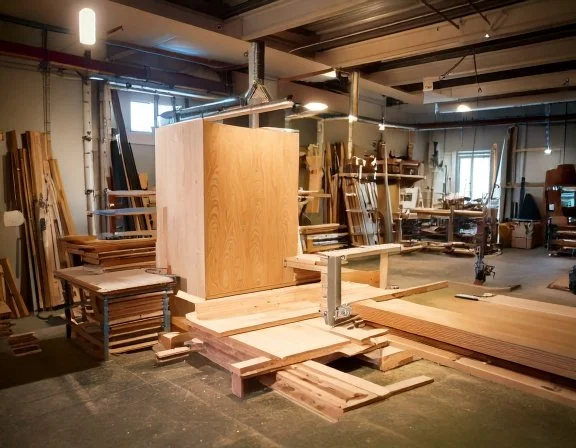
Cabinet-grade plywood in the shop. Cross-laminated layers are why it stays flat while solid panels move.
Why Florida humidity is a woodworking problem
Wood takes on and releases moisture with the air around it, and it moves when it does. In Tampa Bay, outdoor humidity sits high most of the year while air conditioning pulls indoor air dry, so wood in a Florida home rides a constant cycle of swelling and shrinking. Rainy season, a beach-adjacent location, or a room the AC barely reaches makes the swing bigger. A wide solid panel can cup, a cabinet door can twist enough to stop closing square, and a joint that was tight in February can show a gap by August.
None of that means you cannot have beautiful woodwork here. It means the material has to be chosen for the climate, placed where its movement is controlled, and sealed so moisture exchange slows to a crawl. That is the whole playbook, and it has three parts: the box, the visible wood, and the finish.
Why plywood beats solid wood for cabinet boxes
Solid wood looks great but moves a lot with humidity. A wide solid panel expands and contracts across its grain through Florida's seasons, which is exactly the behavior you do not want in the structure of a cabinet. Quality plywood is built from multiple thin layers glued with the grain alternating at right angles, so each layer restrains the next. The result stays flat and stable where a solid panel would cup or split. It also holds screws and joinery better over time, which matters for shelves that carry real weight and doors that get opened every day.
That is why every cabinet and built-in box we build starts as cabinet-grade plywood, not particle board and not wide solid panels. It is the least visible decision in the whole project and the one that most determines whether the piece is still square and tight years from now.
“The material list for a Tampa Bay built-in is not the same as one for a dry-climate build. The climate writes half the spec sheet.”
Where solid hardwood belongs
Solid wood still has its place, and the piece would look flat without it. Face frames, door frames, trim, and visible edges are where solid hardwood earns its keep, because in those parts the wood is narrow enough or captured by joinery so its movement stays controlled. Doors are usually built frame-and-panel for the same reason: the frame holds the shape while the panel floats free and can move with the seasons without splitting.
For painted work we like poplar and maple. Both are stable, take paint cleanly, and hide their grain under a crisp finish. For stained work, white oak and walnut are the ones we reach for: white oak is naturally stable and moisture-tolerant, which is why it shows up in boats and barrels, and walnut brings a depth of color no stain can fake. The key is using solid wood where good joinery controls its movement, not in wide flat panels that fight the climate.
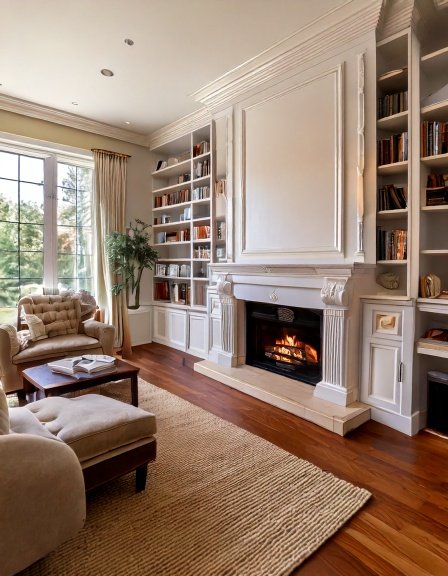
Stain-grade white oak over a plywood box: stable structure inside, furniture-grade wood where you see and touch it.
The materials, side by side
Here is the quick reference for how the common options behave in Tampa Bay homes, and where we will and will not use them.
| Material | Where we use it | In Florida humidity |
|---|---|---|
| Cabinet-grade plywood | Every cabinet and built-in box, shelving, casework | Excellent. Cross-laminated layers stay flat through swings |
| Poplar | Paint-grade face frames, doors, trim | Very good. Stable, affordable, takes paint cleanly |
| Maple | Paint-grade doors and face frames | Very good. Harder than poplar, crisp painted finish |
| White oak | Stain-grade built-ins, cabinets, shelving | Excellent. Naturally stable and moisture-tolerant |
| Walnut | Stain-grade feature pieces and accents | Very good sealed. Premium look, premium cost |
| MDF | Painted panels and some trim, dry rooms only | Use with care. Fine primed and painted, fails if it gets soaked |
| Particle board | We do not use it | Poor. Swells and crumbles with moisture, never recovers |
General guidance for interior built-ins and cabinetry in the Tampa Bay climate. Every project gets a specific material recommendation during the estimate.
Not sure what your project should be built from?
Tell us the room and the look you want. A licensed St. Pete finish carpenter will recommend the right materials for the space, the climate, and the budget, in a clear written estimate.
What to avoid
Most of the wood failures we get called to replace trace back to one of three shortcuts:
Raw MDF or particle board near moisture. Under sinks, in bathrooms, in laundry rooms. It swells and crumbles when it gets wet and never recovers. If MDF belongs anywhere, it is fully primed and painted in a dry room, never bare and never near plumbing.
Cheap pre-fab boxes. Budget cabinetry is usually particle board wrapped in a printed vinyl or paper finish. It can look fine on day one and be sagging or peeling within a few Florida summers. It is the single worst material bet in this climate.
Skipping or thinning the finish. Bare wood absorbs moisture from every unsealed surface, including the backs and undersides you never see. A piece that is only finished where it shows will move more than one sealed all the way around.
Finish is half the battle
Material choice gets you most of the way; finish does the rest. A properly primed and painted surface, or a sealed and clear-coated one on stained work, slows moisture exchange dramatically, which is what keeps doors closing square in October the way they did in April. That is why real prep is not cosmetic fussiness: priming every surface, sealing edges and backs, and building the finish in coats is climate protection you cannot see.
It matters most in the rooms that work the hardest. Laundry rooms, bathrooms, and kitchens combine humidity, splashes, and temperature swings, and they are exactly where a fully sealed finish over the right material pays for itself. The same thinking applies inside closets, where airflow is low and a bare particle-board system can take on a permanent musty swell.
What this means for your project
When you are comparing quotes for built-ins or cabinets in Tampa Bay, ask two questions: what is the box made of, and how is the piece finished. If the answer is particle board, or the finish plan is vague, the price is low for a reason. Plywood casework, hardwood where you see and touch the piece, and a fully sealed finish cost more up front and are the difference between woodwork that lasts years and woodwork that lasts a few summers.
The result of getting this right is simple: built-ins that still look and work the way they should years later, in a climate that punishes shortcuts. If you want to see how material choices translate into project pricing, our guide to what custom built-ins cost in Tampa Bay breaks down the numbers, and the custom built-ins page shows the kind of work this material list produces.
Common Questions